


Cotton Picker Parts Guides
We built this Cotton Picker Parts Guides page to give growers, farm managers, equipment operators, and service teams a practical starting point for finding the right cotton picker parts with less guesswork. Our goal is to make technical parts lookup easier by organizing information around the way cotton pickers are actually serviced in the field. When harvest is underway, delays usually come from misidentified parts, unclear assembly relationships, or waiting too long to replace high-wear components. We use this guides hub to help reduce those problems by connecting parts diagrams, system pages, maintenance references, and brand-specific navigation in one place.
Featured Guides
Cotton Picker Parts Diagrams & Exploded Views
Learn how to use exploded diagrams to confirm part placement, identify part numbers, and navigate system-level assemblies.
Cotton Picker Maintenance & Wear Parts
A practical overview of common wear parts, maintenance planning, and what to inspect before and during harvest.
How We Help Customers Identify Parts
We organize our guides around the most frequently asked questions. In many cases, the first step is not ordering a part. The first step is identifying where that part belongs, how it interfaces with surrounding components, and whether related wear items should be replaced at the same time. Our featured guides are designed to support that workflow and reduce avoidable ordering errors.
Step 1. Browse Parts by Brand

Knowing your machine brand, we recommend starting with one of our brand hubs. Brand-based navigation allows customers to narrow the machine family first, then move into system-level categories, diagrams, and individual part pages. This is often the fastest path for experienced technicians and repeat buyers who work on Case IH or John Deere cotton pickers.
First, choose your Brand.
From the brand hub, customers can drill down by system, then by part group, and finally into specific product pages by part number when available. This structure matters because the same general machine function can have different assemblies, mounting arrangements, and component designs across brands and model generations.
Step 2: Start With the System You Are Servicing
We also organize content around common systems and assemblies because many customers think in terms of the machine area they are servicing rather than the exact part name. A customer may know they need help in the picking unit system, the picking unit cabinet, the belt drive area, or a door assembly, but may not yet know which component within that system has failed. System pages provide a technical bridge between the machine problem and the final part identification. They help narrow the search and create context around adjacent components that may also need inspection.
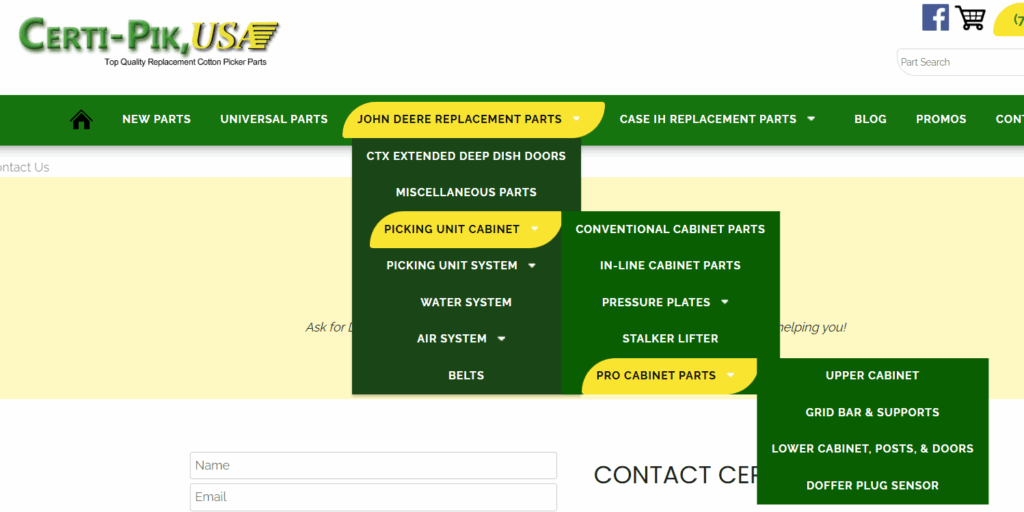
Most customers find parts fastest by starting at a system page, then using diagram-based navigation to confirm part numbers.
These are some of the most commonly used system entry points:
- John Deere Picking Unit System
- Case IH Picking Unit System
- Picking Unit Cabinet Parts
- Cotton Picker Belts
- Case IH Deep Dish Doors
Step 3: Find your part on the Exploded Diagrams
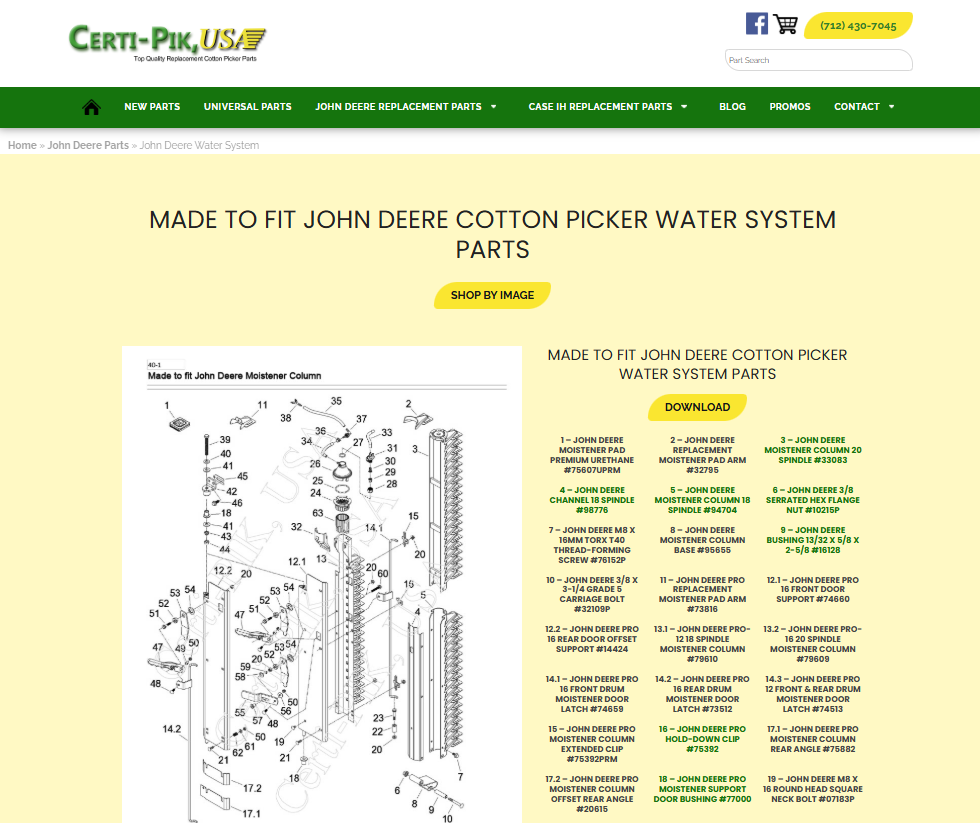
Our Cotton Picker Parts Diagrams and Exploded Views guide explains how to use diagram-based references to confirm part placement, recognize assembly structure, and trace parts back to the appropriate machine system. Exploded views are especially useful when multiple fasteners, covers, brackets, bushings, seals, or rotating parts appear similar at a glance but differ by position or application. When a machine has undergone field repairs over time, diagrams also help restore confidence that the replacement part matches the original assembly layout.
Find your part on the exploded diagram. Then click on the part link on the right to order.
Catalog & Ordering
Certi-Pik uses a quote-based ordering process. You can browse parts, add items to the cart, and submit an order inquiry through checkout.
A representative will follow up to confirm pricing, availability, and shipping options.
How Our Catalog and Ordering Process Works
Our catalog and ordering process is built around technical confirmation. We use a quote-based workflow because availability, pricing, and shipping can vary, and many customers benefit from a final review before the order is completed. On our site, customers can browse parts, add items to the cart, and submit an order inquiry through checkout. After that, a representative follows up to confirm details such as pricing, stock status, and shipping options.
This approach is especially useful for machine-critical parts, time-sensitive harvest purchases, and orders that may involve multiple related components. It also gives us an opportunity to help catch fitment questions before a shipment is processed.
For Australian Customers
If you are ordering from Australia, start here for country-specific information and support links.
For Worldwide Customers
If you are ordering from outside the USA or Australia, please call or use our Contact Us page with any questions. We ship to over 50 countries worldwide including but not limited to:
- USA
- Canada
- Australia
- Greece
- South Africa
- Spain
- Soviet satellite countries
- South America
- Israel
- and multiple countries in Europe and South America.
Why We Created This Guides Hub
We want to help customers move from the machine issue to the correct part number as efficiently as possible. Cotton picker systems are complex and highly interdependent. A failure in one small component can affect picking efficiency, crop handling, airflow, machine cleanliness, and overall uptime. That is why we recommend starting with the correct system, confirming the assembly, and then verifying the exact part number before submitting a quote request or order inquiry. This page serves as the main entry point for that process.
Planning Maintenance and Wear-Part Replacement
Our Cotton Picker Maintenance and Wear Parts guide is intended for customers who need a service-driven approach. Instead of starting with a diagram alone, this guide focuses on common wear points, inspection intervals, and replacement planning before and during harvest. Wear-part management is one of the most important factors in maintaining picker performance. Components that degrade gradually may not trigger an immediate failure, but they can lower picking efficiency, increase crop loss, create feeding inconsistencies, or accelerate damage to adjacent parts. We use maintenance guidance to help customers spot those risks earlier and make better replacement decisions.
Maintenance and Wear-Part Replacement Guide
Our Recommended Parts Lookup Process
We suggest a straightforward workflow for finding cotton picker parts accurately:
- Start with the machine brand and the relevant system if known.
- Use the system page or diagram page to confirm the assembly location.
- Match the part position and description to the correct part number.
- Inspect neighboring wear parts that operate in the same assembly.
- Submit a quote or order inquiry only after confirming fit and application.
This process helps prevent one of the most common ordering problems in cotton picker parts support, which is identifying a part by appearance alone. Many components can look similar in photographs but differ in dimensions, mounting geometry, material specification, or machine compatibility. Diagram-based identification reduces that risk.
Why Technical Confirmation Matters
Once the assembly is visible, it becomes easier to evaluate whether a single replacement is enough or whether a broader service event is more appropriate. This is especially important in high-wear systems where one failed part may indicate progressive wear across related components. By confirming the full assembly first, we help customers make more accurate replacement decisions and reduce the chance of repeat downtime.
What Customers Should Expect from This Page
We designed this page to support three core needs:
- Accurate parts identification
- Faster navigation by brand and system
- Better maintenance planning around wear and replacement cycles
Cotton picker uptime depends on all three. We use this hub to bring them together so customers can move from problem recognition to correct part selection with greater confidence. Whether customers need exploded views, maintenance references, system-level entry points, catalog access, or ordering support, we want this page to function as a reliable technical starting point for cotton picker parts research.