


Cotton Picker Problems During Harvest: Quick Field Fixes and Maintenance Strategies
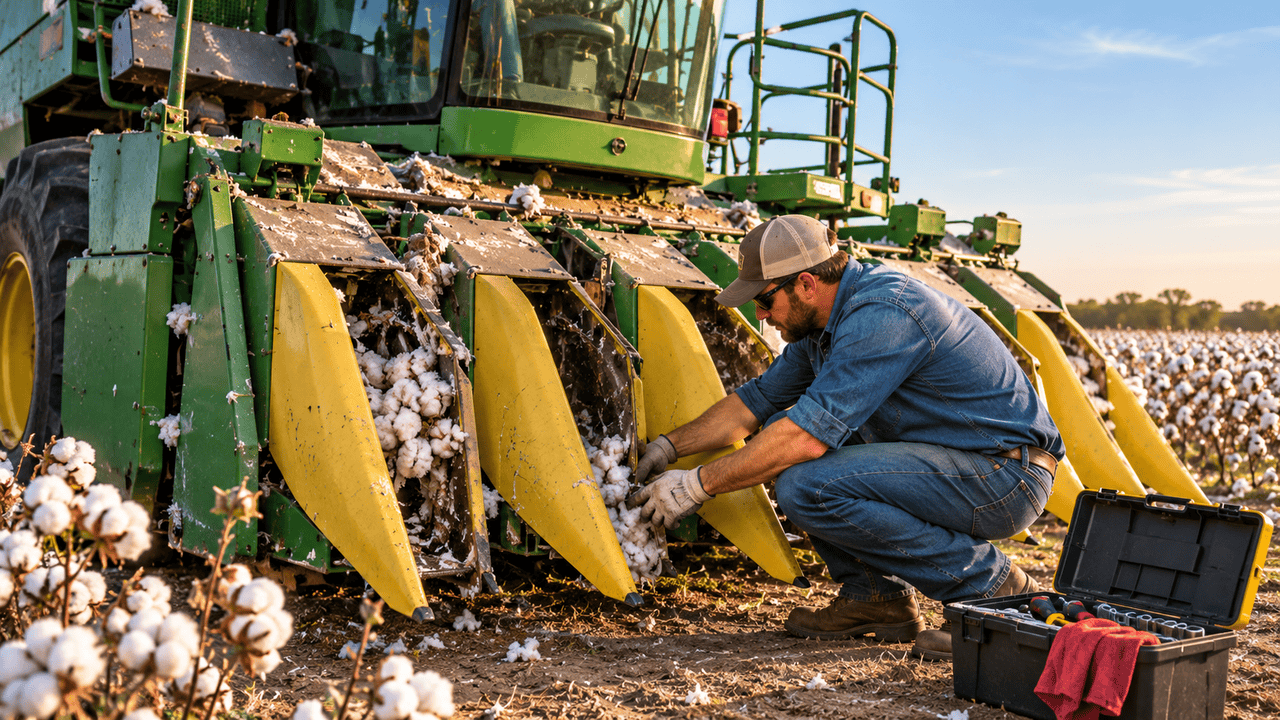
If your machine is sitting idle in the field right now, every hour of downtime is cotton on the ground and money you won’t recover. Peak harvest leaves no margin for extended troubleshooting. Downtime costs too much. You need to identify the problem, apply the right fix, and get back to work before the weather or the calendar takes the decision out of your hands.
Three mechanical problems can interrupt cotton picking during harvest: spindle jams, wear or damage in the gear-driven spindle system, and picking unit misalignment. Resolving them quickly requires clear diagnostic steps, immediate field fixes, and knowing when a part replacement is necessary.
One number worth keeping in mind as you read: according to Iowa State University Extension machinery cost data, built-up repair and maintenance costs on a self-propelled cotton picker reach 79% of its new list price by the time it hits 1,000 operating hours. That curve accelerates sharply through the mid-range hours, which means the machine most likely to fail on you during peak harvest is also the one where a misdiagnosed problem turns into a capital-intensive repair. Getting the diagnosis right the first time matters more than most operators account for.
Diagnosing and Clearing Cotton Picker Spindle Jams
Spindles work by spinning at high speed to wrap cotton fibers off the open boll. That action depends entirely on the spindle rotating freely. The moment friction builds up, the whole picking sequence degrades. That costs you money. Spindle jams typically develop when green weed material, plant sap, or compacted dirt accumulates on the spindle shaft and prevents rotation. The heat generated by a seized spindle then bakes that organic residue into a hard, resinous coating that worsens with every additional row you push through.
The moistening system is your first line of defense against this kind of buildup. Proper water flow combined with the correct soap concentration keeps the spindle surface lubricated and prevents sticky cotton oil from bonding to the shaft. When the moistening system runs dry, runs weak, or uses the wrong dilution, spindles start accumulating residue within a few hours of operation. Watch for localized smoke rising from the drum, an unusually high-pitched squeal from one section of the picking unit, or green cotton wrap appearing on the spindle shaft rather than the doffer. These are the early signs of a developing jam before it reaches the picker bar gears and turns a field fix into a shop repair.
Clearing a spindle jam in the field starts with a full engine shutdown and engaging all safety locks before you touch the drum. Once the machine is secured, manually rotate the drum slowly to isolate the seized spindle: the resistance is obvious compared to the free-spinning spindles around it. Use a spindle wrench to back off the stuck part and physically remove the compacted material from the shaft. Clean the moistening pad for that section while you’re in there, because a clogged pad is almost always part of the story. Before you restart, assess the spindle itself: if it’s bent, if the aggressive teeth are worn smooth, or if the shaft shows heavy scoring from heat friction, cleaning it won’t restore picking performance. A worn spindle leaves cotton on the plant and accelerates wear on the doffer pads. Replacement is the only practical path forward at that point.
Troubleshooting Gear-Driven Cotton Picker Spindles in the Field
Cotton picker spindles are gear-driven, not belt-driven. When a spindle stops turning properly, focus troubleshooting on the spindle itself and its associated gears and drive components. Heavy plant material, accumulated debris, and worn components can interfere with smooth operation during harvest.
Poor spindle rotation can leave cotton on the plant. Look for packed debris, damaged spindle teeth, worn gears, or signs of binding rather than assuming a slipping belt is responsible. Follow the equipment manufacturer’s procedures to determine whether cleaning, adjustment, or replacement is needed.
- Inspect spindle rotation: With the machine shut down and secured according to the operator manual, check for spindles that bind or do not turn as expected. Do not reach into moving picking components.
- Remove debris: Check the spindle and picking area for compacted lint, plant material, and residue. Clean affected components using the manufacturer’s recommended procedure.
- Inspect gears and related parts: Look for damaged or worn gear teeth and signs of abnormal contact or binding. Gear-driven spindle problems require inspection of the appropriate drive components, not belt tension adjustments.
- Check lubrication and service requirements: Follow the manufacturer’s specifications for the gear-driven spindle system. Do not make unsupported adjustments to internal drive components in the field.
- Know when to replace: Bent or worn spindles and damaged gears may need replacement. If the cause of binding or abnormal wear is unclear, stop and consult the service manual or a qualified technician before restarting.
Keeping suitable replacement spindles and other commonly serviced picking-unit parts available can help reduce harvest delays. Use parts specified for the machine model and verify proper operation before returning to the field.
If you’re dealing with spindle wear or picking-unit component failures right now, Certi-Pik has been supplying cotton picker operators with reliable, made-to-fit replacement parts since 1988. BBB-accredited and competitively priced, we keep the parts you need in stock and ready to ship. For information on replacing John Deere picker spindles, browse our spindle catalog or call 888-237-8474 to speak directly with a knowledgeable team member, not an automated phone directory.replacing John Deere picker spindles
Resolving Picking Unit Alignment Issues
The mechanical relationship between the doffers and the spindles is one of the most precision-sensitive interactions in the entire picking unit. Doffers are designed to shear harvested cotton from the spindle surface cleanly, using a controlled gap that allows contact with the fiber without permitting metal-to-metal contact with the spindle shaft. When picking unit alignment drifts, that gap closes unevenly across the height of the drum. The doffers begin grinding against the spindle teeth, wearing them down asymmetrically. This uneven wear pattern compounds with every hour of operation. That ruins your parts.
The real result of misalignment shows up in picking efficiency before it shows up as visible damage. You’ll notice more cotton remaining on the lower or upper portion of the plant canopy, which indicates the spindles in that zone aren’t stripping cleanly. By the time you see shiny, scored spots on the spindle shafts or gouged rubber on the doffer pads, the damage is already costing you yield. Choosing parts that hold the correct tolerances matters considerably here: it’s one of the reasons the discussion around OEM vs aftermarket cotton picker parts ultimately comes down to dimensional precision. A made-to-fit aftermarket part manufactured to tight tolerances will maintain proper alignment just as well as the original; an off-spec part will put you back in this same situation within a season.
Checking alignment in the field starts with the clearance between the doffer column and the front of the spindle. That measurement needs to be consistent from the top of the drum to the bottom. A gap that’s correct at the midpoint but tight at the top indicates the column has shifted or the mounting hardware has loosened. Look for scuffed doffer rubber or shiny wear marks on the spindle shafts as visual confirmation before you pull out the feeler gauge. To adjust, loosen the column locking bolts and use the adjuster screw to bring the doffers into light contact with the spindles, then back off to the manufacturer’s specified clearance. Make small, deliberate increments: the adjuster screw carries more mechanical advantage than it feels like, and overshooting is easy.
- Clean the unit first: Remove all cotton lint and dirt from the doffer and spindle area before measuring anything. Clearance readings taken through packed lint are unreliable.
- Inspect doffer pads: Look for gouges, missing rubber sections, or uneven wear patterns that indicate the column has been running out of position.
- Measure clearance: Use a feeler gauge to verify the gap between the doffer pad and the spindle at multiple points along the column height: top, middle, and bottom.
- Adjust the column: Turn the adjusting screw incrementally, rechecking clearance at all three points after each adjustment rather than assuming the change is uniform.
- Spin the drum by hand: Confirm there is no binding or heavy scraping anywhere in the rotation before restarting.
“Somebody answers the phone when you call and not the normal machine directory. The lady was knowledgeable, took the order, and got us the parts and information we needed at a great price.” – Edward Kane
Preventing Cotton Harvester Downtime: The Cost of Neglect
The cash strain of harvester downtime during peak harvest is obvious to anyone who’s watched a weather window close while waiting on a part. What’s less obvious is how the cost structure of the machine itself changes the calculus as it ages. Aging machines break down. Iowa State University Extension machinery cost data puts the standard economic life for farm machinery at 10 to 12 years. But that lifespan only plays out profitably if operators manage the escalating repair cost curve through regular maintenance rather than waiting for catastrophic failures. Waiting on a machine with 800 or 900 hours means absorbing a repair bill that could represent more than half the machine’s original purchase price, per that same Iowa State data.
There’s a second cost dimension that doesn’t get discussed enough in the context of harvester maintenance: plastic contamination in harvested cotton lint. According to USDA Agricultural Research Service findings, plastic contamination costs the U.S. cotton industry approximately $750 million per year, with a primary source being the plastic module wrap used by round module harvesters. When a harvester’s handling arms or wrap-feed mechanisms are worn, misaligned, or packed with debris, the plastic tears during the wrapping process and fragments enter the processing stream at the gin. The USDA ARS developed the Plastic Image Detection and Ejection System (PIDES), commercially known as VIPR, which achieves 86% commercial efficiency in pneumatically ejecting plastic contaminants before seed cotton reaches the gin stand (per USDA Agricultural Research Service). That technology exists because the mechanical maintenance problem was never fully solved upstream. Keeping your handler parts clean and properly adjusted is the most direct way an operator can reduce their contribution to that $750 million annual industry loss.
Operators running Case IH and John Deere machines who need to move fast on replacement parts can reach Certi-Pik directly. We stock spindles, doffers, moistening pads, cabinet parts, and more, all manufactured to fit and ready to ship from our Iowa facility. As one Arkansas operator put it: “When rebuilding cabinets, Certi-Pik parts fit like OEM and are a fraction of the cost.” – C.W., Arkansas. Browse our Case IH replacement parts inventory or call 888-237-8474 to confirm availability before you lose another day.
Peak Harvest Cotton Picker Maintenance Tips
Staying ahead of mechanical failures during harvest isn’t complicated, but it requires a routine. Do not skip checks. The machines that make it through a full season without a major breakdown are almost always the ones where the operator treats the daily walk-around as non-negotiable rather than optional.
- Daily moistening system check: Verify water flow rate and soap concentration at the start of every shift. Low flow or incorrect dilution is the fastest path to spindle sap buildup, and it’s a five-minute check that prevents hours of jam-clearing.
- Spindle inspection: Walk the drum at the beginning of each shift and look for bent spindles or teeth that have worn flat. A single damaged spindle can accelerate wear on the doffers in that column faster than most operators expect.
- Doffer adjustment: Monitor doffer-to-spindle clearance daily. Dusty and sandy field conditions wear the doffer pads faster than clean field conditions, and a gap that was correct at the start of the day may need a minor correction by midday.
- Lubrication schedule: Grease all critical bearings, cam tracks, and gears on the manufacturer’s specified hourly intervals without exception. Skipping a lubrication interval during peak harvest to save twenty minutes is a reliable way to create a bearing failure that costs you a full day.
- DIY repair resources: For detailed step-by-step guides on in-season servicing procedures, the cotton harvester DIY repairs resource covers common field repairs with the kind of specificity that a general maintenance schedule can’t provide.
Field conditions also affect how hard the machine has to work. Thick, overgrown plant canopies, sometimes associated with excess nitrogen application or over-irrigation earlier in the season, can overload picking units and contribute to debris buildup and spindle problems. When you enter a field with unusually heavy foliage, reduce ground speed and check unit height according to the operator manual before the picking units begin loading up. Slowing down early is often faster than stopping to clear a jam.
Frequently Asked Questions About Cotton Picker Troubleshooting
What causes a cotton picker to leave too much cotton on the plant?
Worn spindle teeth are the most common cause: teeth that have lost their aggressive profile can no longer grip the fiber and pull it from the boll. Misaligned picking units compound the problem by preventing the spindles from penetrating the plant canopy at the correct depth. Insufficient water flow in the moistening system is a third factor: when sap accumulates on the spindle surface, the fiber slides off rather than wrapping, and the cotton stays on the plant.
How often should I adjust my doffer-to-spindle clearance during harvest?
Inspect the clearance daily as a baseline. Machines operating in dusty or sandy conditions may need minor adjustments every 10 to 12 operating hours to account for pad wear. The goal is to maintain clean stripping action without allowing the doffer to make metal-to-metal contact with the spindle shaft. Once you’re hearing scraping rather than a clean shearing sound, the gap has already closed too far.
Why are my cotton picker spindles not turning properly?
Cotton picker spindles are driven by gears, not belts. Poor rotation may result from debris buildup, a damaged spindle, worn or damaged gears, or binding in the drive components. Shut down and secure the machine, inspect the affected area, and follow the manufacturer’s service procedure. Do not try to correct spindle rotation by adjusting belt tension.
How does plastic module wrap damage occur during harvesting?
Wrap damage typically originates at the harvester’s handling arms or wrap-feed mechanisms. Misalignment, sharp burrs on metal contact surfaces, or debris packed into the mechanism causes the plastic to tear during the wrapping process. Those fragments then enter the processing stream at the gin, contributing to the contamination problem documented by USDA Agricultural Research Service. Regular inspection and cleaning of the wrap-feed parts is the most direct preventive measure available to the operator.
Can I run my cotton picker with a few missing spindle teeth?
The machine will run, but the picking efficiency loss is real and measurable. Do not risk it. Dull or missing teeth leave cotton on the plant, and the uneven wear pattern they create accelerates deterioration of the doffer pads in that column. Replacing worn spindles promptly is the better calculation: the yield recovered over the remaining days of harvest almost always exceeds the cost and time of the replacement.
Explore Our Parts Today
Peak harvest is a race with a hard deadline, and the machines that finish it are the ones with operators who treat maintenance as part of the job rather than an interruption to it. Daily inspection, fast diagnosis, and having the right replacement parts within reach are what separate a minor field delay from a breakdown that costs you days. Certi-Pik has been a parts partner for cotton operators since 1988, shipping made-to-fit spindles, doffers, moistening pads, and cabinet parts directly from our Iowa facility. As one North Carolina operator noted: “I could buy elsewhere, but with you having the parts ready to ship and quality I can trust, I prefer to get my parts from y’all.” – M.S., North Carolina. When you need to talk through a parts question with someone who knows the equipment, call 888-237-8474 or write to us at PO Box 248.
Explore our full library of cotton picker maintenance resources for guides, parts catalogs, and technical references built for operators who need accurate information fast. Certi-Pik parts are manufactured to fit, priced competitively, and shipped directly from Iowa to keep your harvest moving.